What Makes JP, China Fully Automatic Balancing Machine Manufacturer Stand Out in Industry
SHANGHAI, SHANGHAI, CHINA, August 25, 2026 /EINPresswire.com/ -- Modern manufacturing networks undergo rapid digital transformation. Facilities must balance high output with extreme quality precision. In the rotating component sector, minor mass inequalities cause severe vibration, noise, and early mechanical failure. As a prominent China Fully Automatic Balancing Machine Manufacturer, Shanghai Jianping Dynamic Balancing Machine Manufacturing Co., Ltd delivers advanced engineering solutions to global production lines. Manufacturers no longer view dynamic balancing as an isolated offline operation. Today, they integrate it directly into smart factory workflows. This structural shift demands highly adaptive, fully automated balancing systems. Therefore, industrial facilities seek partners who combine traditional mechanical precision with advanced digital connectivity. By exploring specific engineering applications, industrial experts can understand how modern balancing machinery achieves flawless production cycles.
Q: How Does JP Eliminate the Trade-Off Between Ultra-High Precision and Rapid Cycle Times for Automotive Micro-Motors?
Automotive micro-motors, such as starter motors and auxiliary window armatures, operate at very high speeds. These components require near-zero residual unbalance to prevent cabin noise and component fatigue. However, high-volume automotive assembly lines demand incredibly short cycle times. To resolve this operational conflict, JP introduces a specialized high-speed armature balancing matrix.
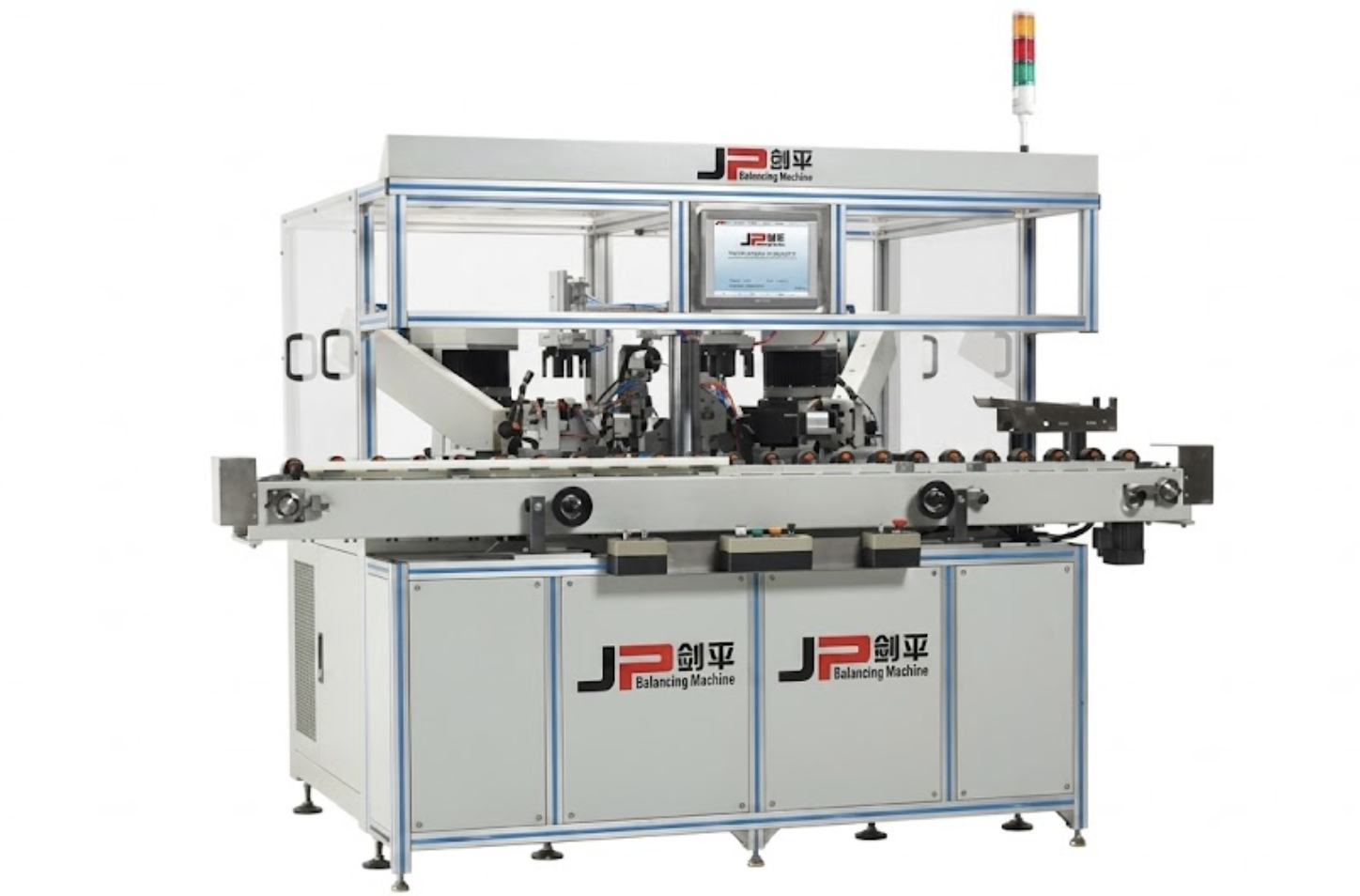
Specifically, the Five-station Weight Removal Wound Armature Automatic Balancer completely automates the balancing sequence. The machine executes initial measurement, precise angular positioning, weight removal, machining, and final verification in a single continuous cycle. This design allows smooth integration with existing automated assembly lines for mass production. Alternatively, the Two-station Milling Wound Armature Automatic Balancer offers a compact footprint for focused milling corrections.
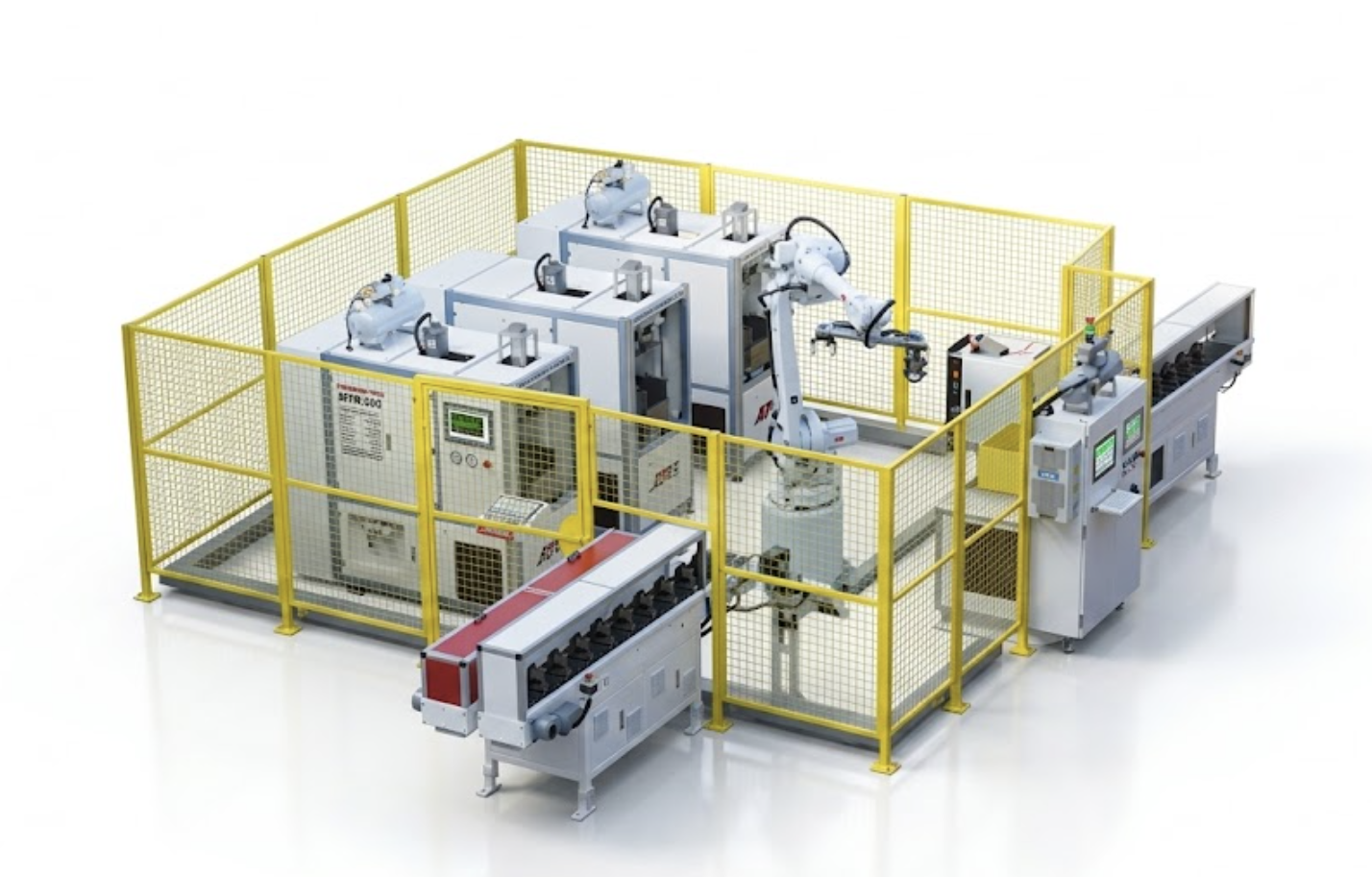
Both systems utilize a highly sensitive soft-bearing structure design. This mechanical choice delivers supreme measurement accuracy even when evaluating small physical masses. Furthermore, the quick-change tooling architecture allows operators to swap component models quickly and easily. Production lines achieve a remarkable initial reduction rate with these setups. Facilities can also attach robotic arms or overhead truss systems to manage component transport automatically, supporting large-scale high-speed production.
Q: What Modular Correction Paradigms Enable JP to Handle the Geometrical Diversity of Flywheels and Pulleys?
Disc-shaped components like flywheels, pulleys, and brake drums present varied geometric challenges. Different materials and physical layouts require distinct mass correction techniques. For instance, some designs demand drilling, while others require punching or welding. A single rigid machine configuration cannot satisfy these diverse industrial requirements.
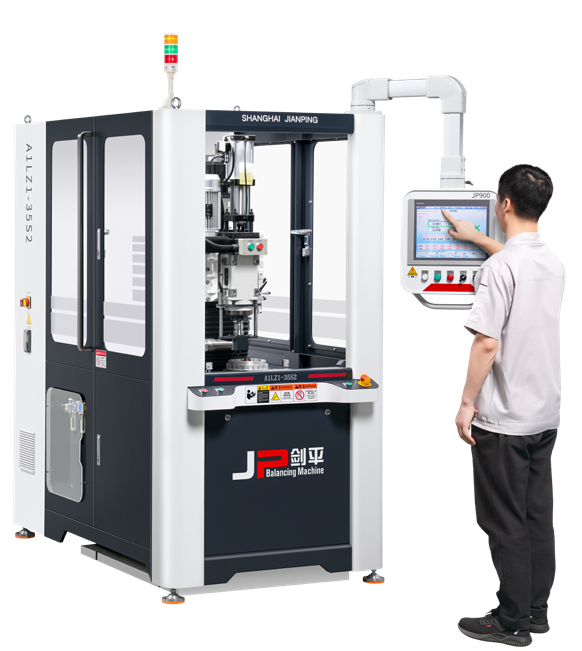
Consequently, the engineering team designs specialized machinery clusters around modular architectures. The Automatic Drilling Balancing Machines provide automated measurement, positioning, and drilling weight removal. For example, the A1LZ1-35E Vertical Drilling Automatic Balancing Machine utilizes a three-axis CNC system to execute highly localized, precise material removal. For components that suit alternative methods, the A1LC1-35 Vertical Punching Automatic Balancing Machine applies high-speed punching forces instead of drilling bits.
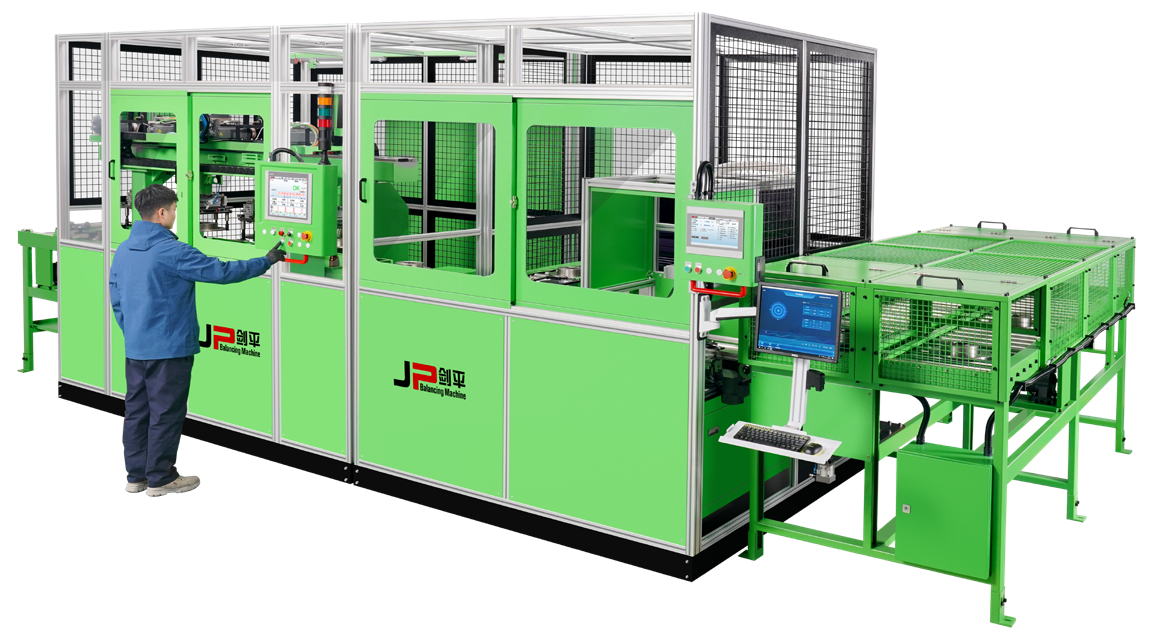
Furthermore, heavy automotive assemblies find targeted solutions in specialized units. The A2LH1-35 Dual-mass Flywheel Welding Two-station Automatic Balancing Machine combines balancing verification with automated welding modules. Meanwhile, the W3LZ1-150 Crankshaft Flywheel Automatic Balancing Machine integrates a robust roller line and an overhead truss system to handle heavier components. For high-volume pulley lines, the A1LZ1-35 Pulley Automatic Balancing Machine utilizes a specialized plastic plate chain line to maintain steady part movement. To ensure clean operation, these systems integrate an automated vacuum chip extraction mechanism that removes metal swarf immediately, preserving sensor cleanliness.
Q: How Does JP’s Multi-Axis CNC Architecture Guarantee Balancing Stability for Complex Asymmetrical Powertrain Components?
Automotive differential cases possess intricate, often asymmetrical structural contours. Traditional balancing tools struggle to locate optimal correction zones on these complex shapes. Improper material removal can weaken the structural integrity of the powertrain housing. Resolving this challenge requires precise multi-axis tool path control during the correction cycle.
To address this engineering obstacle, JP (Shanghai Jianping Dynamic Balancing Machine Manufacturing Co., Ltd ) implements an intelligent multi-axis CNC balancing architecture. The Differential Case Axial Drilling Automatic Balancer delivers highly localized material removal along the axial plane. Alternatively, the A1LZ2 Differential Case Vertical Horizontal Drilling Automatic Balancing Machine permits simultaneous or sequential drilling in multiple planes, adapting perfectly to complex workpiece geometries.
For specialized correction requirements, the Two-Station End Surface Drilling & Milling Automatic Balancer handles precise milling cuts. Production facilities can choose the A2WZ2-5 Differential Case Two-Station Excircle Drilling Machine for external diameter adjustments, or the W4WZ2-5 Four-Station Radial Drilling Machine for radial correction layouts. For massive production scale, the Multi-station Differential Case Automatic Balancer links multiple testing steps into one fluid line. The modular core allows facilities to include extended functions, such as automatic laser marking, barcode scanning, and robotic loading systems.
Q: How Does JP Mitigate Brake Judder and Ensure Traceability in High-Speed Braking Systems?
Brake discs are critical safety components in modern vehicles. Minor balancing errors or geometric irregularities translate directly into brake judder and steering wheel vibration at high speeds. Therefore, manufacturers require simultaneous verification of both physical geometry and dynamic mass distribution during the quality control stage.
The Brake Disc Vertical Milling Automatic Balancer satisfies this dual requirement effectively. Specifically, the A1LX2035400a model incorporates advanced metrology sensors to measure thickness variation before starting the balancing sequence. This step ensures that only geometrically sound discs proceed to the milling stage. The system then utilizes high-precision vertical milling units to extract excess mass from designated correction zones safely.
For ultra-high-volume manufacturing plants, the W6LX20-35 Brake Disc Six-station Automatic Balancing Machine offers an elite solution. This platform utilizes an automated production line with robotic arms or truss loaders to manage parts through six separate stations simultaneously. The system also integrates inline laser coding and laser marking modules. By etching a tracking QR code directly onto the disc surface, the system establishes complete traceability for every individual component.
Q: Beyond Mechanical Calibration, How Do JP’s Smart Factory Integration and 22-Year R&D Heritage Future-Proof Global Manufacturing?
Modern tier-one automotive suppliers do not buy isolated machinery. They require complete data integration across the entire factory floor. Modern quality control depends entirely on end-to-end data visibility. Therefore, advanced balancing platforms must act as active data nodes within the facility.
Every fully automatic machine in the JP portfolio features native compatibility with factory Manufacturing Execution Systems (MES). The internal software automatically scans component barcodes, logs initial unbalance vectors, calculates the precise correction values, and records the final residual unbalance levels. The machine uploads this critical data stream to the central server in real time. This seamless connectivity ensures total compliance with modern automotive quality audits.
This technical capability stems from a deep 22-year corporate foundation of research and development. The enterprise holds an impressive portfolio of over 90 intellectual property assets, including 12 invention patents, 60 utility model patents, and 22 software copyrights. Strict compliance with TUV ISO 9001:2015 and SGS ISO 14001 standards ensures consistent build quality. Furthermore, the official CNAS laboratory accreditation guarantees international traceability for all calibration testing parameters.
Currently, more than 15,000 cooperative customers across 100 countries trust these systems to secure their production quality. To maintain this extensive network, a proactive after-sales service network provides continuous remote diagnostics, software upgrades, and rapid on-site technical support worldwide. This combined infrastructure allows global manufacturers to elevate their production efficiency while maintaining flawless quality standards. For detailed product catalogs and custom automation specifications, please visit the official corporate gateway at https://www.jp-balancer.com/.
Q: How Does JP Eliminate the Trade-Off Between Ultra-High Precision and Rapid Cycle Times for Automotive Micro-Motors?
Automotive micro-motors, such as starter motors and auxiliary window armatures, operate at very high speeds. These components require near-zero residual unbalance to prevent cabin noise and component fatigue. However, high-volume automotive assembly lines demand incredibly short cycle times. To resolve this operational conflict, JP introduces a specialized high-speed armature balancing matrix.
Specifically, the Five-station Weight Removal Wound Armature Automatic Balancer completely automates the balancing sequence. The machine executes initial measurement, precise angular positioning, weight removal, machining, and final verification in a single continuous cycle. This design allows smooth integration with existing automated assembly lines for mass production. Alternatively, the Two-station Milling Wound Armature Automatic Balancer offers a compact footprint for focused milling corrections.
Both systems utilize a highly sensitive soft-bearing structure design. This mechanical choice delivers supreme measurement accuracy even when evaluating small physical masses. Furthermore, the quick-change tooling architecture allows operators to swap component models quickly and easily. Production lines achieve a remarkable initial reduction rate with these setups. Facilities can also attach robotic arms or overhead truss systems to manage component transport automatically, supporting large-scale high-speed production.
Q: What Modular Correction Paradigms Enable JP to Handle the Geometrical Diversity of Flywheels and Pulleys?
Disc-shaped components like flywheels, pulleys, and brake drums present varied geometric challenges. Different materials and physical layouts require distinct mass correction techniques. For instance, some designs demand drilling, while others require punching or welding. A single rigid machine configuration cannot satisfy these diverse industrial requirements.
Consequently, the engineering team designs specialized machinery clusters around modular architectures. The Automatic Drilling Balancing Machines provide automated measurement, positioning, and drilling weight removal. For example, the A1LZ1-35E Vertical Drilling Automatic Balancing Machine utilizes a three-axis CNC system to execute highly localized, precise material removal. For components that suit alternative methods, the A1LC1-35 Vertical Punching Automatic Balancing Machine applies high-speed punching forces instead of drilling bits.
Furthermore, heavy automotive assemblies find targeted solutions in specialized units. The A2LH1-35 Dual-mass Flywheel Welding Two-station Automatic Balancing Machine combines balancing verification with automated welding modules. Meanwhile, the W3LZ1-150 Crankshaft Flywheel Automatic Balancing Machine integrates a robust roller line and an overhead truss system to handle heavier components. For high-volume pulley lines, the A1LZ1-35 Pulley Automatic Balancing Machine utilizes a specialized plastic plate chain line to maintain steady part movement. To ensure clean operation, these systems integrate an automated vacuum chip extraction mechanism that removes metal swarf immediately, preserving sensor cleanliness.
Q: How Does JP’s Multi-Axis CNC Architecture Guarantee Balancing Stability for Complex Asymmetrical Powertrain Components?
Automotive differential cases possess intricate, often asymmetrical structural contours. Traditional balancing tools struggle to locate optimal correction zones on these complex shapes. Improper material removal can weaken the structural integrity of the powertrain housing. Resolving this challenge requires precise multi-axis tool path control during the correction cycle.
To address this engineering obstacle, JP (Shanghai Jianping Dynamic Balancing Machine Manufacturing Co., Ltd ) implements an intelligent multi-axis CNC balancing architecture. The Differential Case Axial Drilling Automatic Balancer delivers highly localized material removal along the axial plane. Alternatively, the A1LZ2 Differential Case Vertical Horizontal Drilling Automatic Balancing Machine permits simultaneous or sequential drilling in multiple planes, adapting perfectly to complex workpiece geometries.
For specialized correction requirements, the Two-Station End Surface Drilling & Milling Automatic Balancer handles precise milling cuts. Production facilities can choose the A2WZ2-5 Differential Case Two-Station Excircle Drilling Machine for external diameter adjustments, or the W4WZ2-5 Four-Station Radial Drilling Machine for radial correction layouts. For massive production scale, the Multi-station Differential Case Automatic Balancer links multiple testing steps into one fluid line. The modular core allows facilities to include extended functions, such as automatic laser marking, barcode scanning, and robotic loading systems.
Q: How Does JP Mitigate Brake Judder and Ensure Traceability in High-Speed Braking Systems?
Brake discs are critical safety components in modern vehicles. Minor balancing errors or geometric irregularities translate directly into brake judder and steering wheel vibration at high speeds. Therefore, manufacturers require simultaneous verification of both physical geometry and dynamic mass distribution during the quality control stage.
The Brake Disc Vertical Milling Automatic Balancer satisfies this dual requirement effectively. Specifically, the A1LX2035400a model incorporates advanced metrology sensors to measure thickness variation before starting the balancing sequence. This step ensures that only geometrically sound discs proceed to the milling stage. The system then utilizes high-precision vertical milling units to extract excess mass from designated correction zones safely.
For ultra-high-volume manufacturing plants, the W6LX20-35 Brake Disc Six-station Automatic Balancing Machine offers an elite solution. This platform utilizes an automated production line with robotic arms or truss loaders to manage parts through six separate stations simultaneously. The system also integrates inline laser coding and laser marking modules. By etching a tracking QR code directly onto the disc surface, the system establishes complete traceability for every individual component.
Q: Beyond Mechanical Calibration, How Do JP’s Smart Factory Integration and 22-Year R&D Heritage Future-Proof Global Manufacturing?
Modern tier-one automotive suppliers do not buy isolated machinery. They require complete data integration across the entire factory floor. Modern quality control depends entirely on end-to-end data visibility. Therefore, advanced balancing platforms must act as active data nodes within the facility.
Every fully automatic machine in the JP portfolio features native compatibility with factory Manufacturing Execution Systems (MES). The internal software automatically scans component barcodes, logs initial unbalance vectors, calculates the precise correction values, and records the final residual unbalance levels. The machine uploads this critical data stream to the central server in real time. This seamless connectivity ensures total compliance with modern automotive quality audits.
This technical capability stems from a deep 22-year corporate foundation of research and development. The enterprise holds an impressive portfolio of over 90 intellectual property assets, including 12 invention patents, 60 utility model patents, and 22 software copyrights. Strict compliance with TUV ISO 9001:2015 and SGS ISO 14001 standards ensures consistent build quality. Furthermore, the official CNAS laboratory accreditation guarantees international traceability for all calibration testing parameters.
Currently, more than 15,000 cooperative customers across 100 countries trust these systems to secure their production quality. To maintain this extensive network, a proactive after-sales service network provides continuous remote diagnostics, software upgrades, and rapid on-site technical support worldwide. This combined infrastructure allows global manufacturers to elevate their production efficiency while maintaining flawless quality standards. For detailed product catalogs and custom automation specifications, please visit the official corporate gateway at https://www.jp-balancer.com/.
Shanghai Jianping Dynamic Balancing Machine Manufacturing Co
+ +86 13817256095
email us here
Legal Disclaimer:
EIN Presswire provides this news content "as is" without warranty of any kind. We do not accept any responsibility or liability for the accuracy, content, images, videos, licenses, completeness, legality, or reliability of the information contained in this article. If you have any complaints or copyright issues related to this article, kindly contact the author above.